Car Battery Dies Overnight? Causes and How to Find the Drain
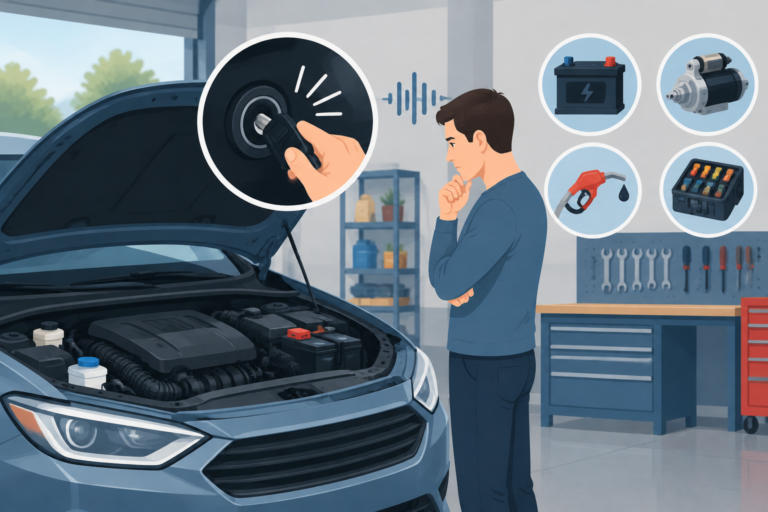
Quick answer : A car battery usually dies overnight because something keeps drawing power after you shut the car off. Common culprits include a stuck light, an aftermarket accessory, or a bad alternator diode. An old battery that won’t hold a charge causes the same problem. A multimeter test for parasitic draw will show which one it is.
You park the car at night, and in the morning you get a click or nothing at all. That’s frustrating, but it’s also a useful clue. A healthy battery in a healthy car should hold its charge for days, sometimes weeks.
This guide covers the usual causes, how to tell a bad battery from a power drain, and a step-by-step test you can do with a basic multimeter. It also explains when to stop and call a mechanic.
The most common reasons a battery dies overnight
Nearly every case falls into one of a few groups. Knowing which one fits your car keeps you from buying parts you don’t need.
1. Parasitic drain
A parasitic drain is any electrical load that stays on after the car is off. Every modern car has a small, normal draw to keep the clock, radio presets, alarm and computer memory alive. Many sources put a normal draw at about 50 milliamps (0.05 amps) or less, though some newer cars with many modules run a bit higher. Your owner’s manual or a service manual for your model gives the real number.
When the draw climbs to several hundred milliamps, a healthy battery can go flat in a night or two.
2. Interior lights and switches that stay on
The simplest drains are the easiest to miss. A glove box light, trunk light, vanity mirror light or dome light can stay lit if a latch or switch fails. You often can’t see it in daylight.
- A trunk or hood that looks closed but isn’t latched fully
- A door that doesn’t register as shut, so the car thinks it’s in use
- A glove box light with a stuck switch
3. Aftermarket accessories
Add-on equipment causes a lot of these problems, especially when someone tapped a constant-power wire to install it. Remote starters, alarms, dash cams in parking mode, amplifiers, GPS trackers and USB chargers can all keep pulling current.
If the trouble started soon after an installation, look there first. Poor wiring or a faulty unit can pull far more than it should.
4. A faulty alternator diode
The alternator contains diodes that convert its output into the direct current your battery needs. They also act like one-way valves. If one fails, current can leak back through the alternator when the engine is off and slowly drain the battery.
Watch for a whining or growling noise from the alternator, headlights that flicker or dim, and a battery light on the dash. A battery that seems to die even after replacement is another hint. A shop can confirm a bad diode with a charging system test.
5. A weak or failing battery
Sometimes there’s no drain at all. The battery just can’t hold a charge anymore. Many car batteries last three to five years, and heat and short trips shorten that.
A weak battery may start the car fine in warm weather, then fail on the first cold night. That’s why many batteries die when the temperature drops.
Other causes worth ruling out
- Loose or corroded terminals. They can block charging and make a good battery act weak.
- Lots of short trips. The alternator never has enough time to refill what the starter used.
- A worn alternator. It may charge poorly even without a bad diode.
- A control module that won’t go to sleep. Modern cars shut their computers down after you leave. A module that stays awake keeps drawing power.
Start with these quick checks
Do these before you pull out a meter. They take about ten minutes and sometimes solve the problem.
- Check the battery age. Look for a date sticker on the case. If it’s over four or five years old, a weak battery is a strong suspect.
- Inspect the terminals. Look for white or blue-green crust, and try wiggling the clamps by hand.
- Look for lights. In a dark garage, check the trunk, glove box and under-dash areas for a faint glow.
- List recent changes. Note any accessory, repair or battery work done just before the trouble began.
- Check for recalls. Some vehicles have electrical or battery-related recalls, so check your car for open recalls and common complaints.
What your battery voltage tells you
A basic digital multimeter set to DC volts gives you a quick snapshot. Measure with the car off and rested for a few hours. These values are approximate, for a standard 12-volt lead-acid battery at moderate temperature.
| Resting voltage | Approximate charge |
|---|---|
| 12.6 volts or higher | Fully charged |
| About 12.4 volts | Around 75% |
| About 12.2 volts | Around 50% |
| 12.0 volts or lower | Mostly discharged |
Next, start the car and measure again at the battery with the engine running. Many charging systems read about 13.7 to 14.7 volts. A reading near battery voltage (around 12) or well above 15 points to a charging problem.
How to test for a parasitic draw, step by step
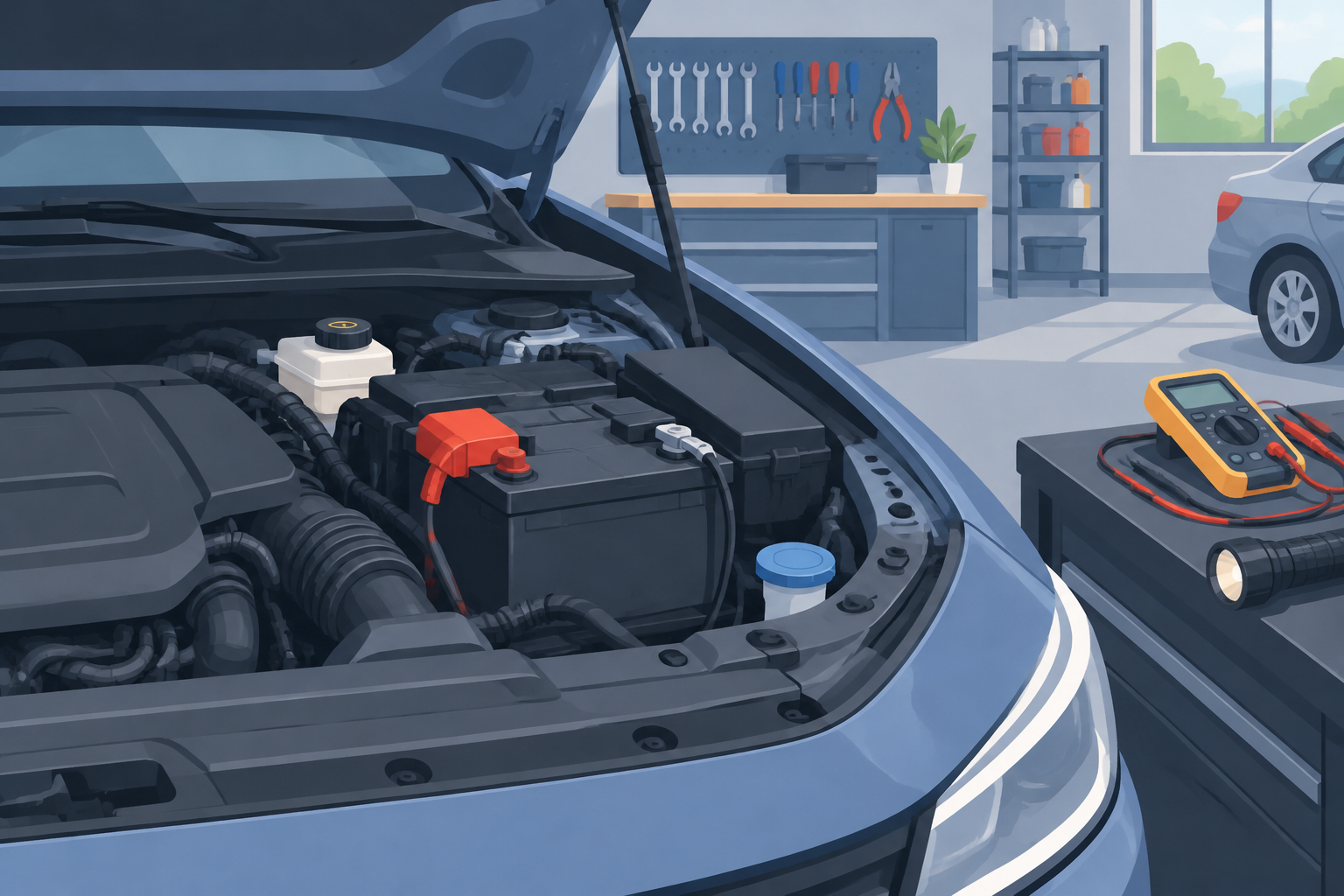
This test measures how much current leaves the battery with the car off. You need a digital multimeter that reads at least 10 amps, a wrench for the terminal clamp, and patience.
Safety first
- Wear eye protection. Batteries can release explosive gas, so keep sparks and flames away.
- Remove rings and watches. Metal across the terminals can burn you.
- Never start or crank the car while the meter is connected. The surge can blow the meter’s fuse or damage it.
- If the battery is dead from a drain and you plan to jump it, charge it fully before testing for the most accurate results.
The test
- Prepare the car. Turn everything off, remove the key or move the fob well away, and close all doors. To keep the car from thinking a door is open, press the door jamb switch in or tape it down, so the door can stay shut.
- Set up the meter. Move the red lead to the 10-amp port and set the dial to DC amps.
- Loosen the negative clamp. Loosen the negative battery clamp but don’t remove it yet.
- Connect the meter in series. Attach one meter lead to the negative post and the other to the loosened clamp, so all current flows through the meter. Then lift the clamp off the post carefully. Don’t let it touch the post again while the meter is attached.
- Wait for the car to sleep. Many cars take 20 to 45 minutes before their modules go to sleep. The reading drops during this time, so wait before you judge it.
- Read the draw. A reading around 50 milliamps (0.05 amps) or less is probably normal for many cars. A reading well above that points to a drain.
- Find the circuit. Pull one fuse at a time, checking the meter after each. When the reading drops sharply, that fuse’s circuit holds the problem. Put each fuse back before pulling the next.
Your owner’s manual shows which components each fuse feeds. If the drain is on a circuit for the radio, alarm or an add-on, inspect those parts and any aftermarket wiring first.
If you can’t get the number to fall, or you aren’t comfortable working near the battery, have a shop do it. Don’t pull fuses for airbags or safety systems unless you know what you’re doing, and leave fuel system parts alone during this test.
Battery problem or charging problem?
Use these patterns to narrow it down.
- The battery is the problem when it’s old, the draw test reads normal, and the car starts after a jump and charges properly while running, but fails again after sitting.
- A drain is the problem when a new or fully charged battery goes flat again within a day or two and the draw reading is high.
- The alternator is the problem when running voltage is low or too high, the battery light comes on, or lights flicker and dim. A bad diode can also show up as a draw on the test.
If the engine only clicks when you turn the key, read what a clicking sound means when your car won’t start. A flashing dash light is a separate issue, covered in why your check engine light is flashing.
When to see a mechanic
Get help if you find any of these:
- The battery keeps dying after you replaced it
- You smell burning plastic or see melted wiring
- The battery case is swollen, leaking or hot
- The drain traces to an airbag, body control or other computer circuit
- You suspect the alternator
Don’t keep driving with a battery light on if the car is losing power, since it can stall without warning. A swollen or leaking battery should be replaced right away.
Costs vary by vehicle and region. As rough estimates, a new battery often runs about $100 to $250 installed, a drain diagnosis may cost $100 to $200, and an alternator replacement commonly falls between $400 and $900. Independent shops often handle this work. Debates over repair data access, such as the New Jersey right to repair lawsuit, affect how easily they can diagnose newer cars.
Frequently asked questions
How long should a car battery last when parked?
A healthy battery in a car with a normal draw can usually sit for a couple of weeks and still start the car. Older batteries and cars loaded with electronics may last less time. If yours dies in a day or two, something is wrong.
Can a bad alternator drain a battery overnight?
Yes. A failed diode inside the alternator can let current leak out of the battery when the car is off. A weak alternator can also leave the battery undercharged, so it dies sooner.
Will a new battery fix a battery that dies overnight?
Only if the old battery was the cause. If a parasitic drain or charging fault is present, the new battery will go flat too, and repeated deep discharges shorten its life.
How many milliamps is a normal parasitic draw?
Many sources cite about 50 milliamps or less, with some newer cars a little higher. Check your service information for your model, since the right figure varies.
Can cold weather kill a battery overnight?
Cold reduces a battery’s available power, so a weak battery can fail on a freezing night even without a drain. A strong battery usually handles cold fine.
This guide is general information. For safety-critical repairs, have your vehicle inspected by a certified mechanic.