
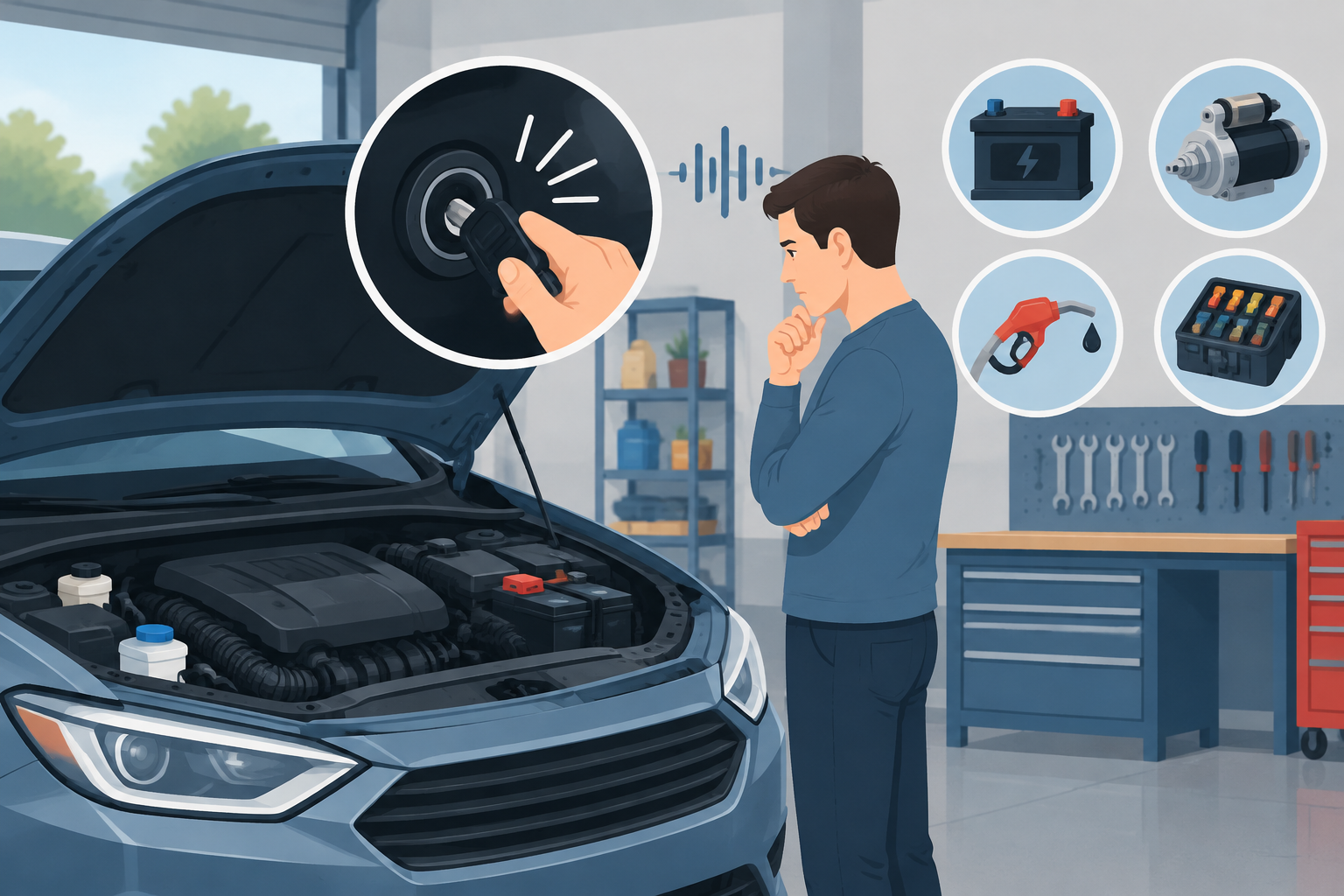
Car Clicks But Won’t Start? What the Sound Means and Fixes
Quick answer: Rapid clicking when you turn the key usually means a weak or dead battery, or loose and corroded terminals. A single loud click usually points to a bad starter, a faulty solenoid, or a poor connection to them. Check your lights and battery terminals first, then try a jump start.
You turn the key, hear clicking, and the engine does nothing. It’s frustrating, but the sound gives you useful clues. The type of click tells you where to look first.
This guide explains what each sound usually means, what causes it, and which checks you can do safely in a parking lot or driveway before you call a mechanic or a tow truck.
What the clicking sound tells you
When you turn the key or press the start button, the battery sends power to the starter. A small switch called the solenoid pushes the starter gear into place and closes the circuit so the starter motor can spin the engine. The click you hear is usually that solenoid, or a relay, trying to work.
If there isn’t enough power reaching it, the solenoid clicks but the motor never turns. How it clicks matters.
| What you hear | Most likely cause | First thing to check |
|---|---|---|
| Fast, repeated clicking (like a machine gun) | Weak or discharged battery, or poor battery connection | Headlights and dome light, battery terminals |
| One loud click, then nothing | Bad starter or solenoid, or a bad connection to the starter | Battery strength, then starter wiring |
| Slow cranking, then clicking | Battery near the end of its life, or very cold weather | Battery age and terminals |
| No click, no lights, nothing | Dead battery or disconnected terminal | Terminals and battery cables |
Rapid clicking
Rapid clicking means the solenoid gets some power, but not enough to hold. It engages, the voltage drops, it lets go, and the cycle repeats many times a second. This is the classic sign of a low battery or a connection that can’t carry enough current.
A single click
One firm click and then silence often means the battery can move the solenoid, but the starter motor doesn’t spin. That could be a worn starter, a failing solenoid, or a loose or corroded wire at the starter. A battery with a good surface charge but little reserve can also do this, so don’t rule the battery out yet.
Common causes, from most to least likely
1. A weak or dead battery
This is the most common cause by a wide margin. Batteries wear out, and many fade somewhere in the range of three to five years, though climate and driving habits change that. Short trips, extreme heat or cold, and lights left on all drain a battery faster.
Signs include dim headlights, a dashboard that flickers when you try to start, and slow cranking in the days before the failure.
2. Corroded or loose battery terminals
The white, blue, or green crust on a battery post is corrosion. It acts like a barrier, so even a healthy battery can’t deliver enough current. A terminal clamp that has worked loose causes the same problem.
This is a cheap, common fix, so always look at the terminals before you buy anything.
3. A failing starter or solenoid
Starters have moving parts, and they wear out. If your lights stay bright while you hear one click, the starter or solenoid moves up the list. Some starters work on one try and fail the next, so the problem seems to come and go.
4. A bad ground or battery cable
The battery cables and the ground strap connect the battery to the engine and body. If a cable is frayed, corroded under the insulation, or loose at the engine block, the starter won’t get full power. The battery can test fine while the car still clicks.
5. A failing alternator that drained the battery
The alternator recharges the battery while you drive. If it fails, the battery slowly runs down until the car clicks and won’t start. A battery warning light on the dash while driving is a hint that this is happening. Our guide to battery and charging warning lights will be a good next read once it’s on the site.
6. Less common causes
- A bad starter relay or blown fuse.
- A shifter that isn’t fully in Park or Neutral, or a faulty neutral safety switch.
- Internal engine problems that stop the engine from turning. This is rare but serious.
Simple checks to do before you call anyone
These steps take about ten minutes and need no tools beyond gloves and possibly a wrench. Work with the engine off and the key out unless a step says otherwise.
- Confirm the gear. Make sure the shifter is fully in Park. Try Neutral and turn the key again. On a manual, press the clutch all the way down.
- Do the light test. Turn on the headlights or dome light, then try to start. If the lights go very dim or out, the battery or its connection is the likely problem. If they stay bright and you hear one click, suspect the starter or solenoid.
- Look at the terminals. Open the hood and check both battery posts for crust or a clamp that looks loose.
- Try the wiggle test. With the car off, grip each terminal clamp and try to twist it by hand. If it moves, it’s loose and needs tightening.
- Check for a locked steering wheel. Turn the wheel slightly while turning the key. A locked column can make the key feel stuck, though it doesn’t normally cause a click.
- Try a jump start. If the battery looks sound, a jump start is the quickest test of whether the battery is the problem.
Cleaning the terminals safely
Corrosion can be cleaned, but a battery holds a lot of energy and releases flammable gas. Wear safety glasses and gloves, keep sparks and flames away, and never let a metal tool touch both terminals at once.
- Turn the ignition off and remove the key.
- Loosen and remove the negative (black, marked minus) cable first, then the positive.
- Scrub the posts and clamps with a wire brush and a mix of baking soda and water. Keep the mix out of the battery cells.
- Rinse lightly, dry everything, and reconnect the positive first, then the negative.
- Tighten the clamps so they can’t move by hand.
Check your owner’s manual first. Some newer cars have electronics that need special care when the battery is disconnected, and you may lose saved settings.
How to jump start the car safely
A jump start tells you a lot. If the car starts right away with a boost, the battery was probably drained or weak. If it still only clicks, the starter, solenoid, or a cable is more likely at fault.
- Park the working car close, without letting the vehicles touch. Turn both off.
- Connect one red clamp to the dead battery’s positive terminal, and the other red clamp to the good battery’s positive terminal.
- Connect one black clamp to the good battery’s negative terminal.
- Connect the last black clamp to bare, unpainted metal on the dead car’s engine or frame, away from the battery.
- Start the working car and let it run for a few minutes, then try the dead car.
- Remove the clamps in reverse order.
Don’t jump start a battery that is cracked, leaking, bulging, or frozen. Batteries can release explosive gas, and a damaged one can burst. Follow the steps in your owner’s manual, since some cars have special jump points under the hood.
If the car starts, drive it for a while and then have the battery and alternator tested. Many auto parts stores test them for free, but call ahead to confirm.
The starter tap trick and its risks
You may hear that tapping the starter with a hammer or wrench can get a worn starter to turn one more time. Sometimes it does, because it can free a stuck internal part. It’s a temporary workaround, not a repair.
It also carries risks. The starter sits near moving parts, hot components, and sometimes the exhaust, and it’s often reached from under the car. Never get under a vehicle held up only by a jack. Never work near the engine with the key in the start position, and keep hands, hair, and loose clothing clear of belts and fans. If you’re not sure how to reach the starter safely, skip this and call a mechanic or a tow.
What repairs usually cost
Prices vary by vehicle, region, and shop. The following are rough estimates only.
- Terminal cleaning: often free to about $30 at a shop, or a few dollars if you do it yourself.
- New battery: commonly around $100 to $300 for a typical car, including installation in many cases.
- Starter replacement: commonly a few hundred dollars, often around $300 to $800, depending on how hard it is to reach.
- Battery cable or ground repair: usually less than a starter, though it depends on the cable.
Ask for a written estimate, and ask the shop to test the battery and charging system before replacing any parts.
When not to keep trying
Stop and call for help if you smell rotten eggs near the battery, see smoke, notice a burning smell, or find the battery swollen or leaking. Don’t keep cranking the engine over and over. Repeated attempts can overheat the starter and wiring.
If the car starts after a jump but dies again soon, don’t rely on it for a long trip. The alternator or battery may be failing, and you could be stranded somewhere worse. If you’re on a busy road, stay away from traffic and call roadside assistance.
Frequently asked questions
Why does my car click but not start with a brand new battery?
A new battery can still be low on charge, or the problem may be elsewhere. Loose or corroded cables, a bad ground, or a failing starter can all cause clicking with a good battery. Have the starting system tested.
Can a bad alternator cause clicking when I try to start?
Yes, indirectly. A failing alternator doesn’t recharge the battery, so the battery drains until it can’t turn the starter. A jump may get you going, but the car will likely stall or fail to restart.
Is a single click always the starter?
No. A single click often points to the starter or solenoid, but a weak battery or a bad connection can produce it too. Checking whether your lights stay bright during the click helps narrow it down.
Can cold weather make my car click and not start?
Yes. Cold reduces a battery’s output and thickens engine oil, which makes the engine harder to turn. An aging battery that worked fine in summer can fail on the first cold morning.
Should I keep turning the key if it clicks?
A few tries are fine, with a pause between each. Many repeated attempts can overheat the starter and drain what’s left in the battery. If it doesn’t start after a few tries, switch to checking and jump starting.
This guide is general information. For safety-critical repairs, have your vehicle inspected by a certified mechanic.