
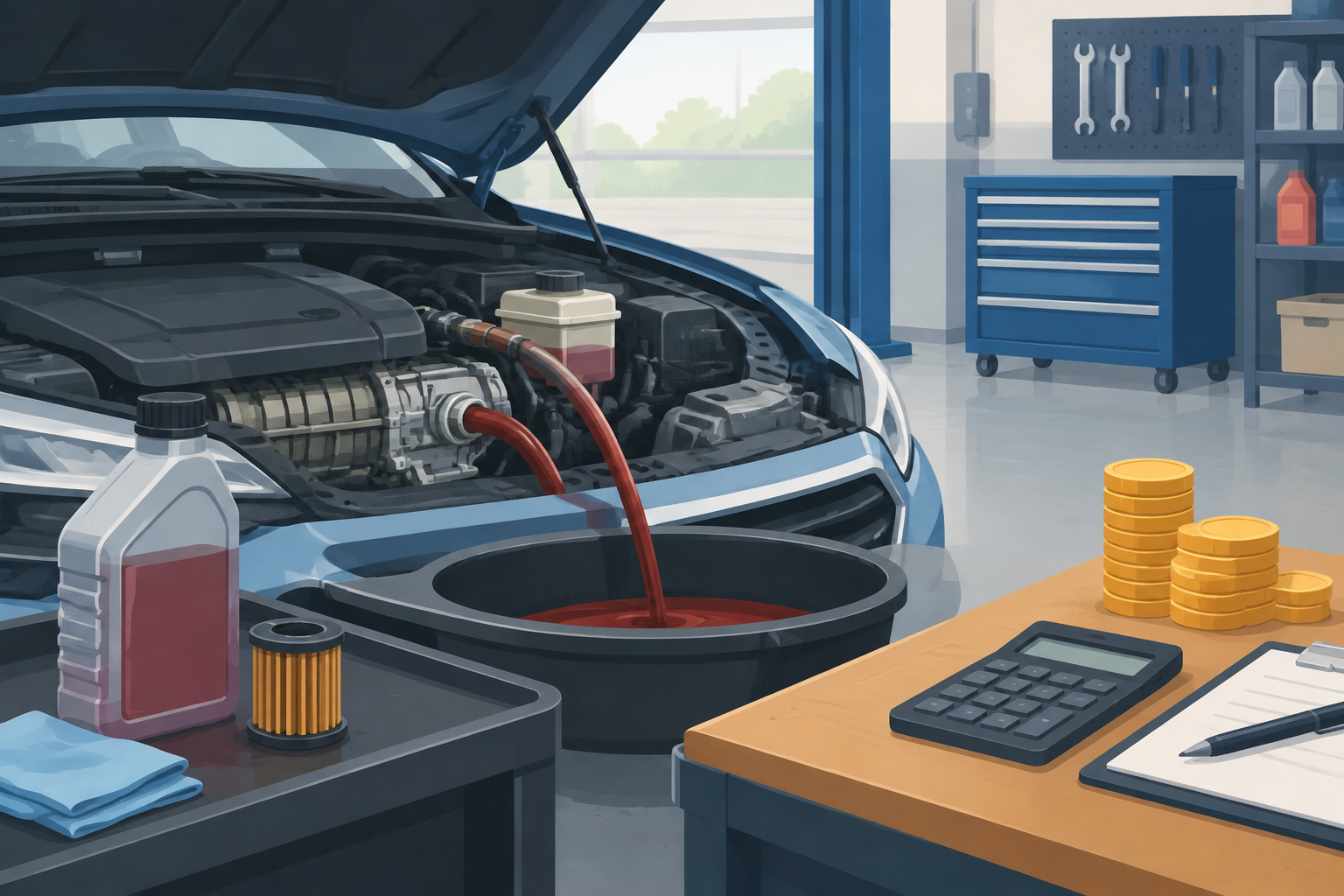
How Much Does a Transmission Fluid Change Cost?
Quick answer: A transmission fluid change usually costs about $100 to $300 for a drain-and-fill and about $150 to $450 for a full flush at US shops. These are estimates. Your price depends on the vehicle, the transmission type, the fluid, and the shop. Dealers, CVTs, and dual-clutch units tend to cost more.
Most drivers pay between $100 and $400 for this service. A simple drain-and-fill on a common sedan lands near the bottom of that range. A flush on a luxury car or a CVT at a dealer can go well above it.
Below you will find typical price ranges, the reasons prices vary, and how to tell whether your car needs the service at all.
Typical transmission fluid change costs in the US
The table shows rough ranges for parts and labor combined. Treat them as estimates. Shop rates and fluid prices change by region and over time.
| Service | Typical range (estimate) |
|---|---|
| Manual transmission fluid change | $70 to $200 |
| Automatic drain-and-fill | $100 to $300 |
| Automatic flush (machine exchange) | $150 to $450 |
| CVT fluid change | $150 to $400 |
| Dual-clutch transmission fluid service | $200 to $500 |
Some shops add a filter or pan gasket charge. If your transmission has a serviceable filter, expect roughly $30 to $100 more for the filter, gasket, and extra labor.
Drain-and-fill vs. full flush
What a drain-and-fill does
The mechanic removes the drain plug or the pan, lets the fluid run out, and refills with fresh fluid. This replaces only part of the total, often a third to half, because the torque converter and cooler lines hold some of the old fluid.
It costs less and takes about 30 to 60 minutes. Many carmakers list this as the standard service, so it is a safe default for regular maintenance.
What a flush does
A flush uses a machine connected to the transmission cooler lines. The machine pushes out old fluid while feeding in new fluid, replacing most of the volume. It uses more fluid and more labor, so it costs more.
A flush can make sense when the fluid is dirty but the transmission still shifts well. Some manufacturers and specialists advise against flushing certain units, so check your owner’s manual first. If a shop pushes a flush on a car whose manual calls for something else, ask them to explain why.
Which one should you pick?
- Follow your owner’s manual. It lists the service method and the exact fluid your transmission needs.
- Choose drain-and-fill for routine upkeep on a car that has been serviced on schedule.
- Ask about a flush only if the manual allows it or a trusted shop recommends it after looking at your fluid.
- Be careful with neglected transmissions. Shops disagree on whether fresh fluid helps or hurts one that has never been serviced at high mileage. Get a second opinion before spending money.
What affects the price
Vehicle type
A compact car holds less fluid than a full-size truck or large SUV. Luxury and European brands often need a specific fluid that costs more per quart. Some of these cars also need special tools or procedures, which adds labor time.
Transmission type
Manual transmissions usually hold less fluid and are simple to service, so they tend to be the cheapest. Traditional automatics fall in the middle. CVTs and dual-clutch transmissions often require brand-specific fluid and a careful fill procedure, which pushes the price up.
Using the wrong fluid in a CVT or dual-clutch unit can cause shifting problems and damage. That is one reason the cheapest quick-lube quote may not be the best deal.
Dealer vs. independent shop
Dealers usually charge more for labor and use factory fluid. Independent shops and transmission specialists often cost less, and many can source fluid that meets your car’s specification. Chain quick-lube shops are often the cheapest, but confirm they stock the right fluid for your exact model.
Fluid type and amount
Conventional fluid costs less than full synthetic or specialty fluid. Quarts add up fast. A job that needs 4 quarts costs far less than one that needs 12 or more.
Where you live
Labor rates run higher in big cities and on the coasts than in smaller towns. The same service can differ by $50 or more between two regions.
When a transmission fluid change is recommended
Your owner’s manual is the best source for the interval. Some cars call for a change at a set mileage, and others list a range based on how you drive. Intervals vary a lot between makes, so do not rely on one number you heard from a friend.
Harder driving usually calls for earlier service. Check the severe-duty schedule in your manual if any of these describe you:
- You tow a trailer or haul heavy loads.
- You drive mostly in stop-and-go city traffic.
- You live in a very hot climate or drive in mountains often.
- You use the vehicle for deliveries, rideshare, or taxi work.
Signs your fluid may need attention
Check the fluid if your car has a dipstick. Healthy automatic fluid is usually red or pink with a mild smell. Dark brown or black fluid, a burnt smell, or visible metal particles are warning signs.
Symptoms that point to a problem include:
- Slipping gears or a delay when you shift into drive or reverse
- Harsh or jerky shifts
- Whining, humming, or clunking noises
- A transmission warning light or a check engine light
- Red fluid spots under the car
A leak or a slipping transmission is not a job for a fluid change alone. Have a mechanic look at it soon. If the car barely moves, shifts violently, or smells strongly of burning, stop driving it and arrange a tow. Continued driving can turn a small repair into a replacement.
When you can skip it
Some cars have a transmission labeled as sealed or filled for life. That usually means the manufacturer lists no routine service interval, not that the fluid lasts forever. Many mechanics still suggest a change at some point if you keep the car a long time, so ask a shop that knows your model.
You can reasonably skip the service in these cases:
- Your manual lists no service interval and you drive gently.
- The car is new and still under warranty with its own service rules.
- You plan to sell or scrap the car soon and it shifts normally.
Check your warranty terms before skipping anything. Some warranties require proof of scheduled maintenance, so keep your receipts either way.
Can you do it yourself?
A drain-and-fill is possible at home on some cars, and it can cut the bill to the cost of fluid and a few tools. It is not a beginner job on every vehicle. Many transmissions have no dipstick, require a specific fluid temperature during the fill, or need a special pump.
The risks are real. A car held up only by a jack can fall, so use jack stands on level ground. Too little or too much fluid, or the wrong type, can damage the transmission. Hot fluid can burn you, and used fluid must go to a recycling center or an auto parts store that accepts it. If your owner’s manual calls for a special procedure, let a shop handle it.
How to save money without cutting corners
- Read your owner’s manual for the fluid type and service interval.
- Get quotes from a dealer, an independent shop, and a transmission specialist.
- Ask what fluid they will use and whether it meets your manufacturer’s specification.
- Ask for a written estimate that lists fluid, filter, gasket, and labor separately.
- Decline add-on additives unless the shop can explain why your car needs them.
Paying a bit more for the correct fluid and a careful procedure usually costs less than a transmission repair later. Replacement or rebuild costs can run into the thousands, depending on the car.
Frequently asked questions
How often should I change transmission fluid?
Follow your owner’s manual, since intervals differ widely by make, model, and transmission type. Shorten the interval if you tow, drive in heavy traffic, or live somewhere very hot.
Is a transmission flush worth the extra money?
It can be, since it replaces more of the old fluid. It only makes sense if your manufacturer or a trusted mechanic approves it for your car. For regular upkeep, a drain-and-fill is often enough.
Can a fluid change fix a slipping transmission?
Sometimes fresh fluid improves mild shifting problems caused by old or low fluid. If the transmission is already worn, new fluid will not repair it. Get a diagnosis before paying for the service.
Why is CVT fluid service more expensive?
CVTs often need a brand-specific fluid and a precise fill process. That raises both the parts cost and the labor time compared with a standard automatic.
Do manual transmissions need fluid changes?
Yes, though usually less often than automatics, and the service typically costs less. Check your manual for the interval and fluid type.
This guide is general information. For safety-critical repairs, have your vehicle inspected by a certified mechanic.